
English Bridge Program (EBP)
Overview
Aimed at building academic and professional communication skills, the English Bridge Program (EBP) offers not only a head start in university education to madrasa-educated students and others; it also seeks to equip its participants with proficiency in entrepreneurial and social interaction in the English language. The structure and content of EBP is curated for its target population of learners. Spread over three terms, the program lays a functional foundation for the students’ academic and professional needs in English.
The English Bridge Program (EBP) is an intensive English diploma aimed at building academic and professional communication skills for ESL learners. The program offers a head start in university education—particularly for madrasa-educated students and Intermediates. EBP provides an immersive learning environment. The curriculum is based on the Oxford 3000/5000-word lists, that develops academic English alongside academic, professional, entrepreneurial, and everyday social communication. Spread over two focused semesters, the structure and content of the program are curated for its target population of learners and draw on a wide range of cutting-edge language learning resources, including AI-enabled software, interactive intelligent technologies, as well as traditional instructional tools and methods. EBP – qualified participants can achieve CEFR B2+ (IELTS up to 6.0) *On-campus accommodation is available for interested students.
Program Structure
| Program Structure | 2 Semesters |
|---|---|
| Total Number of Credit Hours | 27 Credit Hours per week. |
| Program Shifts & Timings | Regular - Full Time |
| Days and Timing | Saturday – Thursday | 08:00 AM to 05:00 PM |
Eligibility Criteria
Applicants must have completed their Higher Secondary School Certificate (Intermediate/Grade 12) or an equivalent qualification to be eligible for admission into the EBP Diploma program.
In the first semester, which lasts 16 weeks, participants gradually progress from an elementary level of proficiency to higher levels in key areas of communicative mastery. While the core aspects of language learning (grammar and vocabulary, listening and speaking, reading and writing) will mainly be emphasized, this semester will also focus on teaching students to engage with both physical and digital communication platforms effectively.
One central goal of the program is to bring all students up to par with one another in terms of their motivation and to streamline their competencies in ways that benefit the majority
The second semester reinforces the learning outcomes of the first semester, but the spotlight now is on applying the skills acquired in specific domains of social and virtual interaction.
Students enhance their grasp of English sound and meaning structures while applying their skills to achieve specific communication goals. They hone their English proficiency in Semester II by indulging in blogging, podcasting, and bilingual translation projects. Students also work towards independence in academic literacy, engaging in multidisciplinary reading and writing as well as university-grade speaking and listening assignments.
Courses
Working in the area of listening comprehension introduces learners to a variety of English accents – not merely to familiarize them with the different styles and rhythms of World Englishes but to enable them to comprehend speakers of English from different parts of the world. Also, listening modules expose participants to different genres of communication, including talks, presentations, interviews, discussions, vlogs, and documentaries. It includes different types, i.e. Gist understanding, listening for minute details, selective scanning, and inferential comprehension.
This course helps you become a confident communicator by balancing strong listening skills with clear, effective speaking. You will practice listening to a wide range of World Englishes, getting used to different global accents and styles through vlogs, interviews, and presentations. On the speaking side, you will learn how to start natural conversations, tell organized stories, and explain complex ideas using simple analogies. To make sure you are understood everywhere – from a university in Pakistan to a professional setting abroad – the course includes personalized pronunciation practice to polish your rhythm and stress. By the end, you will be able to handle everything from casual chats to professional negotiations with ease and clarity.
Units on pronunciation seek to standardize the patterns of natural speech of learners. While learners are formally introduced to the sound system (pronunciation, stress, and intonation) of British and American English, the objective here is to make their speech intelligible not only within the Pakistani university settings but also internationally. Given the multilingual classroom context, pronunciation work requires individual customization, based on the native language of each learner.
The Language Lab will serve as a digital space where ESL learners of the EBP will improve their listening and speaking through technology. It will provide a private environment where learners will record their voices and compare them to native speakers to perfect their pronunciation. Additionally, the lab will use interactive software and membership in the British language schools to provide instant feedback, allowing students to learn at their own pace. Ultimately, this facility will build the confidence and fluency students will need for real-world communication.
All modules are built around CEFR-aligned vocabulary from the Oxford 3000- and 5000-word lists around three objectives: laying a foundation in academic vocabulary; building an expanding repertoire of situational phrases and thematic words and expressions; and setting up a broad-based system for vocabulary growth and lexical troubleshooting.
Grammar will be taught and practiced within the context rather than in isolation
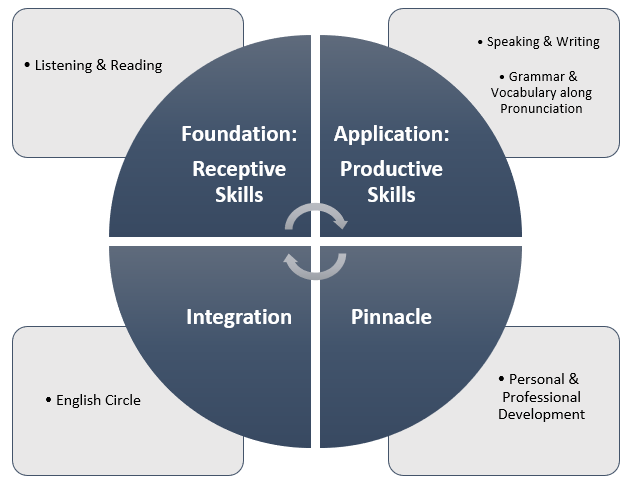
Coursework in this area covers reading strategies and skills that enable students to tackle journalistic prose as well as academic writing according to various reading purposes. Work on ‘extensive reading’ builds their reading stamina, even as they develop micro and macro speed reading skills. Work on intensive reading empowers students to critically examine texts and raise and respond to analytical questions
This component of the EBP curriculum focuses on developing students’ analytical and persuasive writing skills, which they apply in various project domains. Through a communication process approach, students not only learn to craft various types of compositions but also learn to produce book reviews, academic summaries, and project reports.
The English Circle is designed to support ESL learners in applying their productive skills (such as speaking and writing) in the form of creating a portfolio: podcasts, blogs, intra- and inter-university contests, lectures, speeches, debates, and other confidence-building activities.
Under Personal & Professional Development Sessions (PPDS), students learn how to construct, design, and deliver presentations related to their field and life. They also learn how to participate in meetings and engage in discussions steered towards decision-making. Moreover, for their personal and professional development, workshops and guest speaker sessions will be organized, such as Smart Time Management, AI in Academics, Effective Study Skills, Reflective Habits, and many more